by Association for Software Testing | Syndicated
The other day, while pairing up on some unit test, I started to realize that I generally have three modes of looking at my unit tests. The Writing Mode While writing, I mostly focus on the mechanics of getting the test to pass. By then, I usually have…
by Association for Software Testing | Syndicated
At TestBash Manchester I did a presentation titled “A road to awesomeness”. In this talk I tried to explain how testers can become awesome. I talked about learning and testing skills. To prepare this talk I created a mind map to list skills and ways to learn. The mind map is here and will be […]
by Association for Software Testing | Syndicated
Last year, I spent a fair amount of my presentation time talking about ideas behind Inclusive Design, and how the both enhance and help contribute to performing Accessibility testing. One of the resources I suggested was the Inclusive Design Toolkit developed and used by the University of Cambridge. In addition to a wealth of information on their site, their methods go beyond software. Since they test numerous physical items, they do not rely on software tools only but have actual physical tools that you can use.
One of those is their Cambridge Simulator Gloves. These are rigid pieces of flexible plastic that can be adjusted to simulate a variety of physical issues with hands (e.g. rheumatism, arthritis). These are seriously cool pieces of kit, but they are pricey (£155 per pair, which is at this writing close to $200). Less expensive but also seriously cool are the Cambridge Simulation Glasses. These are considerably less expensive (£30 for a set of five glasses, which is less than $40 as of this writing), and therefore are easier for individuals looking to dabble in Inclusive Design to do so. The University of Cambridge is quick with orders and I received mine within a week of placing it. For shipments coming from the UK to the USA, really, that’s pretty good.
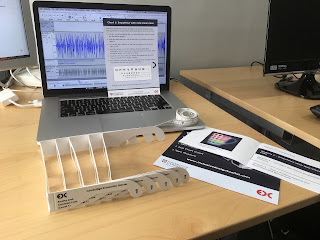 |
| Here’s the single user Cambridge Simulation Glasses pack. |
OK, so what in the world is this?
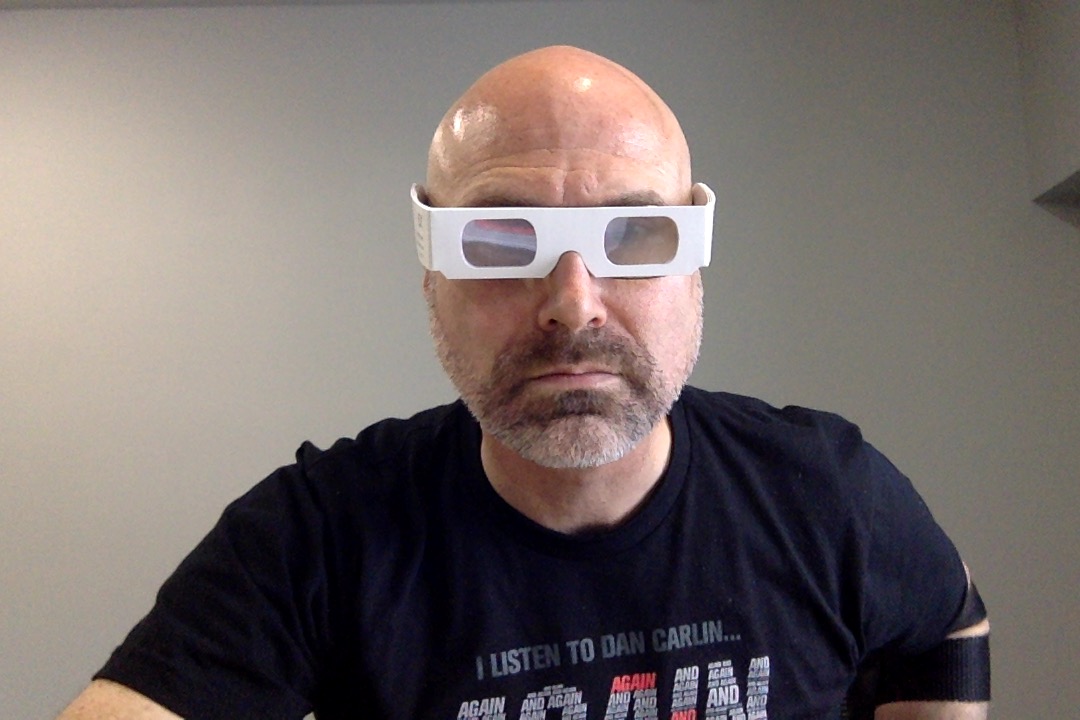
The idea behind the simulation glasses is that you as an individual can experience progressive vision loss. Personally, I can already empathize because I have developed classic middle-aged person near-sightedness; I need readers to type this blog post, for example:
 |
Not a fashion accessory, but also not a permanent fixture on my face (yet).
I do need them anytime I try to read or type anything. |
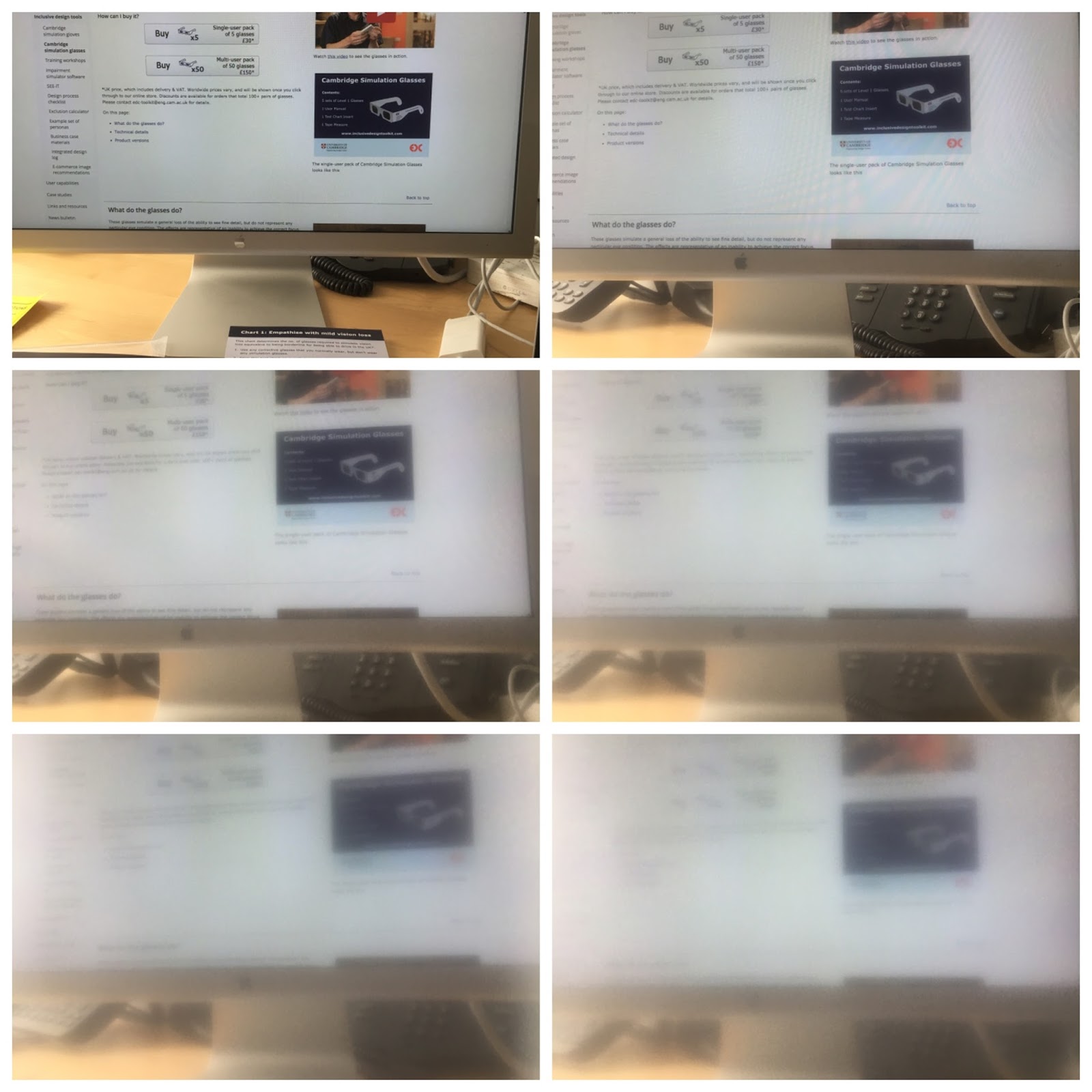
If you are not already wearing prescription glasses, contacts, or need readers just yet, you may be wondering how you might be able to simulate mild vision loss. The simulation glasses do exactly that. Just put a pair on, and you will experience a little bit of fuzziness to your vision. If you want to intensify the effect, put on another pair of glasses over the top of the ones you are currently wearing. The kit comes with five pairs of glasses, and believe me, by the time you have put on all five, you will find it challenging trying to read much of anything.
If you wear glasses, you wear these over the tops of the ones you are wearing to give you a graduated simulation.
|
| The loss of visual quality as you stack glasses. |
The image above gives you an idea as to how fuzzy your vision gets with these, but it is even more jarring as you actually wear them. aAt the maximum level, you can really see how frustrating it is when you try to look at a screen or an object that has low contrast. Trying to determine what it is, much less how to use it, can be a real struggle. Again, there are software tools that simulate this, but there’s something very interesting about being able to put on these graduated “fuzz” devices and try to do everyday tasks I take for granted.
For those who are interested in experiencing your apps, or your everyday products in a new way, and to develop a bit of empathy for your less visually normative friends (and those who live long enough will most likely get to join our ranks), then I do encourage getting these simulation glasses. They are worth the expense, and they do help reshape and reframe the way you see the world… or don’t see it, in this case.
by Association for Software Testing | Syndicated
So the other day, while listening to Testing in the Pub with Keith Klain, as it happens, a thought that made me chuckle popped into my head. And when, an hour or two later, I was still chuckling, I tweeted it.
Testical Debt: the
#testing that is prioritised out of a cycle and then later kicks you in the … well, later really hurts you.
— James Thomas (@qahiccupps) October 25, 2016
The tweet format can be a sweet format because the detail is left to the reader’s imagination. But I wanted to add a couple of notes.
The term is a pun on technical debt:
In this metaphor, doing things the quick and dirty way sets us up with a technical debt, which is similar to a financial debt. Like a financial debt, the technical debt incurs interest payments, which come in the form of the extra effort that we have to do in future development because of the quick and dirty design choice.
And, while the tweet is funny because we’ve all felt that kind of pain due to that kind of debt in our testing effort at some point (and because testicles are just inherently funny), it fails to acknowledge an extremely important point.
Sure, we have to prioritise testing work, like pretty much all other work. Sometimes the work we don’t do turns out to have been important. Sometimes we suffer because of that. Often this is because the assumptions we held when prioritising were incorrect, or circumstances have changed and they are no longer valid.
But – and this is the important point – sometimes that is also true of the work we did do. Every action we take is a gamble. Sometimes it will pay off, and sometimes it won’t, as I somehow found myself telling *cough* Kent Beck recently.
@KentBeck Yes, and everybody takes risks repeatedly. They just mostly aren’t aware of that. (Or of what all the outcomes are.)
— James Thomas (@qahiccupps) October 19, 2016
Image: https://flic.kr/p/tEsAP
by Association for Software Testing | Syndicated
It’s been a while since my last blog post, I took a long break for the summer, but I am still not done with figuring out what software testing is. Just as a quick overview of what happened until now, the basic idea behind all of that was that I am still seeing people being […]
The post Software testing is.. part 1 – exploratory. appeared first on Mr.Slavchev().




Recent Comments